

The great French brands are a history of France you can walk through in one Paris afternoon. Hermès, Cartier, Louis Vuitton, Chanel, Dior: five houses that built the birthplace of haute couture. We tell them here in the order they were founded, which turns out to be a story in itself, from saddles to the New Look in barely a century.
This is our original selection, rebuilt for learners, because there is a detail most visitors miss: these names are French words, with French pronunciations, attached to very French stories of family, craft, and stubbornness. Knowing them is culture. Saying them correctly is a small daily victory over the language.
So here they are: the five houses, their origin stories, the pronunciation traps, and the shopping French to carry into the boutiques.
Why Do French Brands Rule Fashion?
France did more than produce luxury houses. It invented the vocabulary the whole industry still uses: haute couture (high dressmaking), prêt-à-porter (ready-to-wear), maison (house), atelier (workshop). When fashion needed words, it borrowed them from French and never gave them back.
The deeper reason is heritage. Each of these five houses began as a craftsman solving a practical, unglamorous problem: saddles, trunks, cockpit watches. Each then built on that craft for a century or more. That story, more than any logo, is what the world is really buying.
For a French learner, the brands are a gift: five stories packed with dates, family sagas, and vocabulary. Every one of them opens a conversation with a French speaker.
The 5 French Brands at a Glance
| # | House | Founded | Began as | Icon |
|---|---|---|---|---|
| 1 | Hermès | 1837 | Horse harnesses | Birkin bag |
| 2 | Cartier | 1847 | Jewellery | Santos watch |
| 3 | Louis Vuitton | 1854 | Travel trunks | Monogram luggage |
| 4 | Chanel | 1909 | Hats, then liberation from corsets | The Chanel suit |
| 5 | Dior | 1946 | The New Look | Miss Dior perfume |
The Five Houses, in Order of Birth
1. Hermès (1837): say "air-MESS"
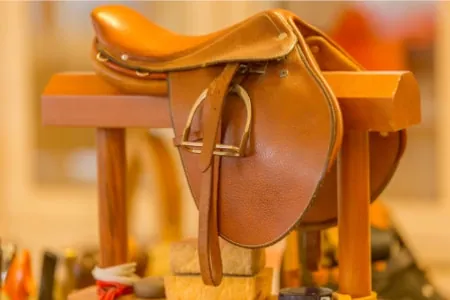
The oldest house on this list began in 1837 as a horse-harness workshop in Paris, founded by Thierry Hermès. European royalty prized its saddle stitching. The leap to handbags came from inside the family: Émile-Maurice Hermès, the founder's grandson, designed the house's first leather handbag because his wife had searched Paris and could not find one she liked.
That gesture became a dynasty of bags, including the Birkin, perhaps the most wanted handbag on Earth. The house is still guided by the founding family, six generations on, with Pierre-Alexis Dumas as artistic director. The official Hermès site (opens in a new tab) still sells saddles: a century and a half of craft refusing to forget where it started.
The pronunciation trap: the H is silent and the S is not. Air-MESS, never "her-meez."
2. Cartier (1847): say "kar-tee-AY"
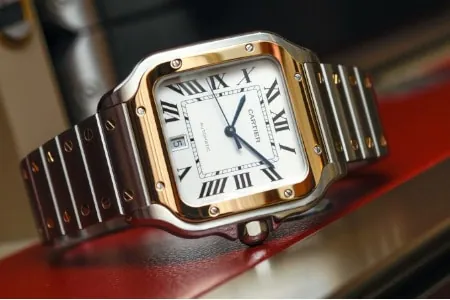
Louis-François Cartier founded his jewellery house in 1847, and for half a century it served society's elite in the classic way. But the story every watch lover knows comes later. In 1904, Brazilian aviator Alberto Santos-Dumont complained to his friend Louis Cartier that pocket watches were useless in a cockpit.
Cartier's answer, the Santos, became one of the first men's wristwatches, and it changed how the world tells time. In that era, wristwatches were considered women's jewellery and men carried pocket watches. One pilot's complaint changed the custom.
What began as elite jewellery became the house that put watches on the world's wrists. The Santos is still in the catalogue, a 120-year-old answer to a practical problem.
3. Louis Vuitton (1854): say "loo-EE vwee-TON"
Louis Vuitton began as a trunk-maker in 1854, building flat-topped, stackable luggage for a new age of rail and steamship travel. It was a practical revolution before it was a fashion one. The monogram canvas came later, as a defence against counterfeiting. It went on to become the most copied pattern in fashion history. Irony has a sense of humour.
Today the house's flagship at 101 avenue des Champs-Élysées spans 1,800 square metres of couture, ready-to-wear, and accessories. It is the largest Louis Vuitton store anywhere, and a destination in itself even if you only come to look.
The pronunciation trap: no "S" sound anywhere. Loo-EE, not "Lewis."
4. Chanel (1909): say "sha-NEL"
Gabrielle "Coco" Chanel built her house on an idea that was genuinely radical for 1909: clothes women could move and breathe in. She rejected the corset outright; she never accepted its restriction. In 1925 she launched the collarless, elegantly tailored Chanel suit that redefined what elegance meant.
Her influence runs through everything the modern wardrobe takes for granted: the little black dress, jersey fabric as fashion, the quilted handbag on a chain. Chanel redirected fashion history. Photographs of muses like Marie-Hélène Arnaud in the suit carried the revolution worldwide.
For learners, she also left the language a perfect quote to use any time: la mode se démode, le style jamais (fashion goes out of fashion, style never does).
5. Dior (1946): say "dee-OR"
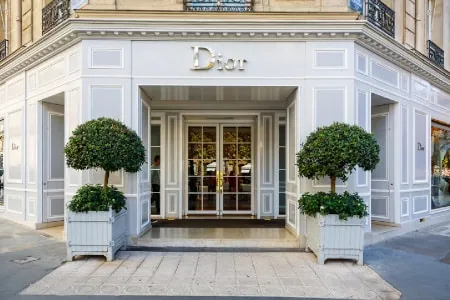
The youngest house here made the loudest entrance. Christian Dior opened at 30 avenue Montaigne in 1946. He chose the address deliberately, close to a hotel full of international clients. His first collection's narrow waists and full skirts were instantly named the New Look by the fashion press.
The house's first perfume, Miss Dior, launched in 1947 with a floral heart of Grasse rose, jasmine, and patchouli. The fragrance line it started is half the empire today. From one address and one silhouette, Dior rebuilt French fashion's confidence after the war.
How Do You Visit the Maisons Like a Local?
A few tips from our teachers' own Paris habits:
- Walk the golden triangle. Avenue Montaigne, rue du Faubourg Saint-Honoré, and the Champs-Élysées hold most of the flagships within a 20-minute walk of each other, Dior's 30 avenue Montaigne included.
- Go to look, even if you don't buy. The flagships are effectively museums with door staff. Window-shopping (faire du lèche-vitrines, literally "window-licking") is a respected French pastime with its own official idiom.
- Visit the actual museums. Several houses run exhibition spaces; fashion exhibitions in Paris sell out like concerts, so check ahead.
- Buy the small thing. A scarf, a notebook, a lipstick: the entry-level pieces carry the same house story as the handbags, at a hundredth of the handbag's price.
What French Do You Need for Shopping in Paris?
The boutiques of avenue Montaigne all speak English. Even so, French changes the interaction entirely. The essentials:
- Bonjour, je peux regarder ? (Hello, may I look around?) The bonjour is mandatory; browsing without one is the classic tourist error.
- Je cherche un cadeau pour… (I'm looking for a gift for…)
- Est-ce que je peux l'essayer ? (May I try it on?)
- C'est un peu au-dessus de mon budget. (It's a little above my budget.) Said with a smile, perfectly respectable, even at Hermès.
- Je vais réfléchir, merci beaucoup. (I'll think about it, thank you.) The graceful exit.
And one listening tip: store staff will use madame and monsieur constantly. It is not formality aimed at you personally; it is the register of the setting. Enjoy it. Few places let you hear formal French this polished.
Planning the full trip? Our guides to the top French restaurants in Paris and the best French-speaking cities to visit cover the eating and the itinerary; this piece covers the shopping bags. And for a French fix without the flight, the French gift ideas in Vancouver guide brings the boutiques to you.
From Brand Names to Real French
Here is the pattern we have noticed: the people most delighted by correctly saying Hermès are beginners. Pronunciation wins are the first wins, and they come fast with a native teacher correcting you in real time.
The brand names are also secret pronunciation teachers. The silent H of Hermès, the swallowed S of Louis, the -ier ending of Cartier: each one is a rule of French phonetics wearing a famous label. Learn the five names properly and you have learned five rules.
That is how our classes work. The French Transformation program takes complete beginners to conversational French in 6 months with native French teachers from France and Quebec. Classes have a maximum of 14 students, and pronunciation is drilled from day one. Learn French in Vancouver has taught 4,500+ students since 2017, in Vancouver and online across Canada.
Want French built around travel, fashion, or business? Private French lessons shape the sessions around your world, luxury-industry French included. It is a real request we get.
"I had a really great experience with Maiwen. The service was excellent, and I learned so much about French. The teaching was clear and engaging, making it easy and fun to improve my language skills. I highly recommend Maiwen to anyone looking to learn French effectively!"