

The best French cartoons solve a problem every learning family knows: how do you keep a child (or, honestly, an adult) interested in French long enough for it to stick? The answer, tested by generations of Francophone families: make it an adventure with a magic potion in it.
This is our original family list, rebuilt as a learning guide. These five classics suit kids aged roughly 8 and up. They also work for adults, who will discover that "cartoon French" is some of the most useful listening practice at the early levels.
For each one: what it is about, why French kids grew up on it, and what it teaches a learner's ear. At the end, a simple family routine turns the watching into actual French. It also answers the question every parent asks at some point: what about me?
Why Are Cartoons So Good for Learning French?
Cartoons are made for young ears, and a learner's ear works the same way. The speech is clearer and slower than adult TV, the vocabulary is everyday, and the pictures carry the meaning whenever the words go too fast.
They are also a fast lesson in culture. Astérix, Tintin, and Le Petit Nicolas are the shared childhood of the whole Francophone world, quoted at dinner tables from Paris to Montreal. Mention them and every French speaker you meet smiles.
And for families, they solve the motivation problem better than any app. A child asks for the next episode; nobody has ever asked for the next grammar drill.
One more thing parents in BC should know: children who build an ear through French cartoons arrive in French immersion programs ahead of the group. BC's immersion seats fill fast every year. The families who treat French as fun, not homework, are the ones still speaking it in June.
The 5 French Cartoons at a Glance
| # | Cartoon | Origin | Best age | What it teaches |
|---|---|---|---|---|
| 1 | Astérix and Obélix | France, comics since 1959 | 8+ | Clear dialogue, wordplay names |
| 2 | Lucky Luke and Les Daltons | Belgium/France | 8+ | Simple plots, repeated vocabulary |
| 3 | Tintin | Belgium, since 1929 | 8+ | Adventure French, clean diction |
| 4 | Le Petit Nicolas | France, books since 1959 | 6+ | A child's everyday vocabulary |
| 5 | Titeuf | Switzerland | 10+ | Playground slang |
The Cartoons
1. Astérix and Obélix
A village of unbeatable Gauls, a druid's magic potion, and the entire Roman Empire failing to cope. Astérix began as a comic in 1959, created by René Goscinny and Albert Uderzo. It grew into films and series the whole Francophone world knows by heart.
For learners, the joy is in the names and wordplay: the druid Panoramix, or the bard Assurancetourix (a pun on "all-risk insurance"). The dialogue is clear enough for young ears to follow. Start with Astérix le Gaulois, the original film, then let the family vote its way through the rest of the series.
The story never gets old: a magic potion, temporary superpowers, and the Roman Empire losing with dignity, twice per film.
One practical tip: watch a French version with French subtitles. The jokes your child misses by ear, they will catch by eye. So will you.

2. Lucky Luke and Les Daltons
The cowboy who "shoots faster than his shadow" spends his days calmly stopping the four Dalton brothers: Joe, the oldest, smartest, and angriest; William and Jack, the middle two nobody can tell apart; and Averell, the youngest and hungriest.
The formula is a learner's friend: the same situations and the same vocabulary return every episode, so understanding builds fast. By the fifth episode your child is finishing the Daltons' sentences, in French.
Created in Belgium in 1946, and later written by Astérix's own René Goscinny, Lucky Luke is also an easy history lesson: the Wild West, told in French, with a horse named Jolly Jumper who is smarter than most of the villains.
3. Tintin
Belgium's gift to the world: a young journalist, his dog Milou (Snowy in English), the impulsive Captain Haddock, the hard-of-hearing Professor Calculus, and the detectives Dupont et Dupond. The Adventures of Tintin has been translated into more than 100 languages since 1929.
Tintin's French is crisp, standard, and clearly spoken. It is the neutral accent teachers dream of. The adventures have real stakes: smugglers, moon rockets, lost treasure. That keeps older kids, and every adult we know, watching to the end.
A word on the sidekicks: Captain Haddock's creative insults (moule à gaufres !, "waffle mould!") are a beloved corner of French culture in themselves, and completely safe for young ears.
Start with Les aventures de Tintin en Amérique, or any album your library has. The animated series follows the books almost panel by panel.

4. Le Petit Nicolas
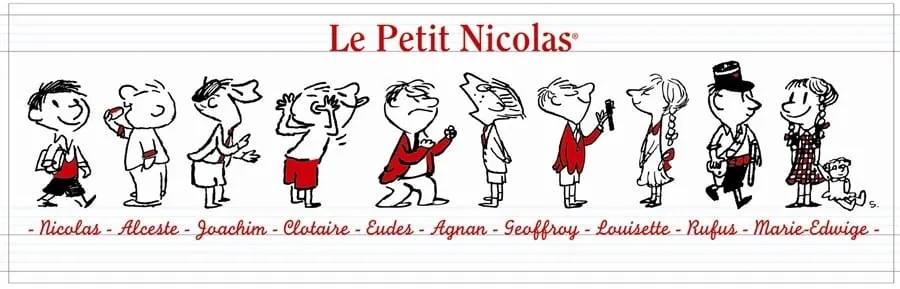
Nicolas is the shortest boy in his class, rich in friends and opinions, and the whole story is told in his voice. Le Petit Nicolas began as a book series in 1959, written by René Goscinny and illustrated by Jean-Jacques Sempé, before becoming a beloved cartoon. Yes, that is Goscinny's third appearance on this list. One writer built half of French childhood.
Because the narrator is a child, the entire series runs on a child's everyday vocabulary: school, parents, friends, recess, and the small injustices of being the shortest in class. For adult beginners this is quietly perfect. It is the vocabulary of daily life, delivered at a child's pace.
The cast is a joy: Alceste the ever-eating best friend, Rex the dog whose real name is Kiki, and a schoolyard of characters your family will adopt.
5. Titeuf
From Swiss cartoonist Zep, Titeuf is the kid with the blond quiff dealing with school, crushes, and the mysteries of the adult world. He has the cheekiest vocabulary on this list, which is why we suggest it for ages 10 and up.
Its value for learners is the opposite of Tintin: playground French, the informal register kids actually use with each other. If your child will attend French immersion or a francophone school, Titeuf is real-world research.
Parents sometimes hesitate at the cheekiness. Our view: the slang in Titeuf is the slang of every French schoolyard. Hearing it in context, with the social consequences on screen, is the safest possible way to learn what it means.
How Do You Turn Cartoon Time into French Time?
Watching alone builds familiarity. A few small rules turn it into real progress. None of them add screen time; they only add purpose:
- French audio, French subtitles. For readers, subtitles double the input. For younger kids, audio alone is fine; the pictures do the translating.
- Short and daily beats long and rare. One 20-minute episode a day works better than a weekend marathon.
- Let them rewatch. Children happily watch the same episode 5 times, and that repetition is the single most powerful feature of kids' content.
- Talk about it after, in simple French. C'était drôle ? (Was it funny?). Even one question keeps the language active.
- Use Canadian sources. ICI TOU.TV and Radio-Canada's youth programming (opens in a new tab) stream French kids' content legally in Canada, and they expose the family to Quebec voices early.
- Pair watching with reading. Astérix, Tintin, and Le Petit Nicolas all began on the page; our guide to French books for 10-year-olds continues the same characters in print, and essential French expressions gives the family phrases to use at dinner.
What About the Parents?
Here is a pattern we see constantly: a family starts French for the kids, and 6 months later it is a parent who needs the language most. The reason is work, a move, or Canadian permanent residency, where strong French can be worth up to 50 Comprehensive Ranking System points.
Cartoons are a real start for adults too: Le Petit Nicolas at first, Titeuf when your slang is ready. But adults have an option kids do not have: structured classes that turn years of slow absorption into months.
If your schedule is the obstacle, the Self-Study Course packages our beginner curriculum into videos you can watch after bedtime. It is the grown-up version of one episode a night.
That is what we do. The French Transformation program takes adult beginners to conversational French in 6 months, with native French teachers from France and Quebec, online across Canada or in person in Vancouver, with a maximum of 14 students per class. Learn French in Vancouver has taught 4,500+ students since 2017. A good number of them are parents keeping up with their kids.
Want something the whole household can share? Private French lessons can be shaped around a family, including sessions built on the very cartoons in this list.
"I was looking for a French teacher, and I'm so glad that I found Maiwen because she is extremely kind, nice, and always happy to help us out. Even in group classes, she takes time to make sure each student understands the pronunciation of each word and is able to learn the language in a fun way. She makes the classes very interactive by allowing us to learn French through things that happen in our daily lives"