
The classic French dishes are a language lesson disguised as a menu. Whether you're planning a trip to Paris or just love French cuisine, knowing these 10, and how to order them in French, turns every restaurant table into a classroom with better food.
This is our original top 10, kept intact and rebuilt for learners: each dish comes with its story and a real ordering dialogue you can use word for word, in France, in Quebec, or at a French bistro in Vancouver.
Food is where most of our students speak their first real French sentence outside class. Let's make sure it's a good one.
Why Learn French Through Food?
Restaurant French is the highest-frequency French there is. You can live in France for a week without discussing philosophy; you cannot survive a day without ordering something.
France takes the subject seriously enough that the "gastronomic meal of the French" is listed on UNESCO's cultural heritage list (opens in a new tab): the whole ritual of aperitif, courses, pairings, and conversation.
The vocabulary also compounds beautifully. Learn je voudrais (I would like) for a crêpe, and you own the phrase for train tickets, hotel rooms, and pharmacy counters too.
And there's a cultural key here: in France, food talk is small talk. Being able to discuss dishes with genuine opinions is one of the fastest ways into any French conversation.
The 10 French Dishes at a Glance
| # | Dish | Region | What it is |
|---|---|---|---|
| 1 | Crêpes | Brittany | Thin pancakes, sweet or savoury |
| 2 | Confit de canard | Gascony | Duck slow-cooked in its own fat |
| 3 | Coq au vin | Burgundy | Chicken braised in wine |
| 4 | Bœuf bourguignon | Burgundy | Beef stewed in red wine |
| 5 | Ratatouille | Provence | Stewed summer vegetables |
| 6 | Soupe à l'oignon | Paris | Onion soup, gratinéed cheese |
| 7 | Steak tartare | France-wide | Seasoned raw beef |
| 8 | Quiche lorraine | Lorraine | Savoury tart, bacon and cream |
| 9 | Macarons | Paris | Almond meringue sandwiches |
| 10 | Tarte Tatin | Loire Valley | Upside-down caramel apple tart |
The Dishes, and How to Order Them
1. Crêpes
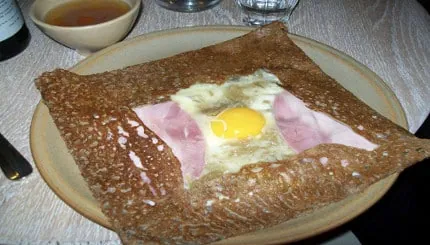
Brittany's gift to the world: paper-thin pancakes served sweet (crêpes sucrées) or savoury, when they're properly called galettes and made with buckwheat flour. Fillings run from a simple squeeze of lemon and sugar to the classic complète: ham, egg, and cheese.
- You: Je voudrais une crêpe au Nutella, s'il vous plaît. (I'd like a Nutella crêpe, please.)
- Server: Bien sûr, une crêpe au Nutella, c'est délicieux ! (Of course, a Nutella crêpe, it's delicious!)
2. Confit de canard
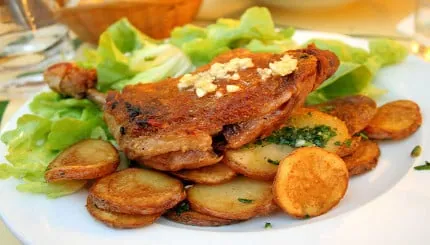
A Gascony specialty: duck marinated in salt, garlic, and thyme, then slow-cooked in its own fat until it falls off the bone. The technique began as a way to preserve meat and survived as pure pleasure. It's traditionally served with potatoes roasted in the same fat, évidemment (obviously).
- You: Quels sont les accompagnements pour le confit de canard ? (What comes with the duck confit?)
- Server: Il est servi avec des pommes de terre rôties et une salade. (It's served with roasted potatoes and a salad.)
3. Coq au vin
Chicken braised slowly in wine with mushrooms, bacon, and onions, the dish Julia Child made famous in North America. Traditionally made with rooster, today usually chicken or capon. Regional variations swap the wine: coq au vin jaune in the Jura, coq au Riesling in Alsace.
- You: Je prends le coq au vin. (I'll have the coq au vin.)
- Server: Oui, c'est un excellent choix avec un verre de vin rouge. (Yes, an excellent choice with a glass of red.)
4. Bœuf bourguignon
Burgundy's beef stew, braised in red wine with garlic, onions, and mushrooms. It's the textbook example of simple French country cooking that became haute cuisine. The Charolais cattle behind it are celebrated at their own festival every August.
- You: Est-ce que le bœuf bourguignon est servi avec des légumes ? (Does it come with vegetables?)
- Server: Oui, avec des carottes et des champignons, dans une sauce riche. (Yes, carrots and mushrooms in a rich sauce.)
5. Ratatouille
Provence in a pot: tomatoes, zucchini, eggplant, garlic, onions, and herbs, stewed together, or, for purists, each vegetable cooked separately and only then combined. A main course for some, a side for others, and thanks to a certain animated rat, the most famous French dish name in the world.
- You: La ratatouille est-elle végétarienne ? (Is the ratatouille vegetarian?)
- Server: Oui, c'est un délicieux mélange de légumes frais. (Yes, a delicious mix of fresh vegetables.)
6. Soupe à l'oignon
France's midnight classic: onion soup under a lid of toasted bread and melted Gruyère, with caramelized onions underneath giving it its deep flavour. Parisian legend puts its origins in Les Halles, where market workers needed something hot and cheap at 3 AM.
- You: Une soupe à l'oignon pour commencer, s'il vous plaît. (An onion soup to start, please.)
- Server: Très bon choix, elle est gratinée au fromage. (Very good choice, it's topped with melted cheese.)
7. Steak tartare
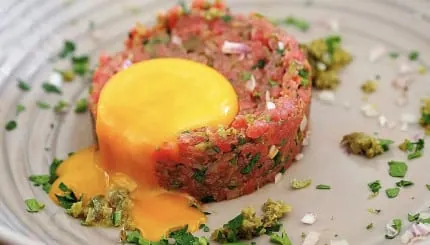
The bold one: high-quality raw beef, hand-chopped and seasoned with capers, onions, mustard, and a raw egg yolk. Ordering it earns instant respect from any French table, and it's genuinely delicious.
- You: Le steak tartare, il est préparé comment ? (How is the steak tartare prepared?)
- Server: Haché à la main, avec câpres, oignons et un jaune d'œuf. (Hand-chopped, with capers, onions, and an egg yolk.)
8. Quiche lorraine
From Lorraine, on the German border: a buttery pastry shell filled with cream, eggs, and lardons (bacon pieces). The authentic version has no cheese, a fact French people will tell you whether you ask or not.
- You: La quiche lorraine, c'est avec ou sans fromage ? (Is the quiche lorraine with or without cheese?)
- Server: La vraie, c'est sans fromage : crème, œufs et lardons. (The real one is without cheese: cream, eggs, and lardons.)
9. Macarons
Two almond-meringue shells around a ganache heart, in every colour a pâtissier (pastry chef) can dream up. Paris made them famous; the rest of the world made them an obsession. Vancouver has real ones too, as our gift-ideas guide below shows.
- You: Une boîte de six macarons, s'il vous plaît. Quels parfums avez-vous ? (A box of six macarons, please. What flavours do you have?)
- Server: Pistache, framboise, chocolat, vanille, café et citron. (Pistachio, raspberry, chocolate, vanilla, coffee, and lemon.)
10. Tarte Tatin
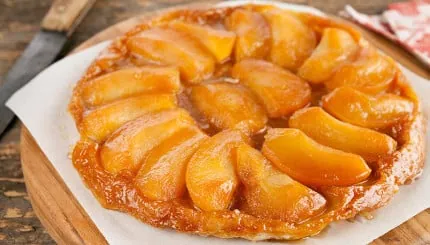
The happy accident: an apple tart baked upside down, which caramelizes the fruit. Credit goes to the Tatin sisters of the Loire Valley, who supposedly rescued a failed dessert and created a classic. Order it tiède (just warm); cold tarte Tatin is a missed opportunity.
- You: Et en dessert, la tarte Tatin, elle est servie chaude ? (And for dessert, is the tarte Tatin served warm?)
- Server: Oui, tiède, avec de la crème fraîche. (Yes, warm, with crème fraîche.)
How Do You Order Food in French?
A handful of phrases covers 90% of any restaurant visit:
- Une table pour deux, s'il vous plaît: a table for two, please.
- Je voudrais… / Je prends…: I'd like… / I'll have… (the 2 phrases you'll use most when ordering).
- Qu'est-ce que vous recommandez ?: what do you recommend? (the surest way to warm up any server).
- L'addition, s'il vous plaît: the bill, please.
- C'était délicieux !: it was delicious. Say it; it matters in France.
Practice these out loud before you need them. The difference between reading a phrase and having said it 10 times is the difference between freezing and ordering.
One cultural rule beats all the vocabulary: always open with bonjour. In France, ordering without a greeting is noticed right away. The greeting is where the exchange really begins.
The best practice is a real French table close to home. Our guide to the best French restaurants in Vancouver lists where our teachers actually eat, and the French gift ideas guide covers the city's French bakeries and cheese shops for practicing between meals.
Here's the honest truth: you can memorize every dialogue above and still freeze when the server answers something unexpected. The problem there isn't vocabulary. It's conversation practice, and that's exactly what live classes give you.
The French Transformation program takes complete beginners to conversational French in 6 months with native French teachers from France and Quebec, max 14 students, with role-plays like restaurant scenes built into the method. Learn French in Vancouver has taught 4,500+ students since 2017, in Vancouver and online across Canada.
Planning a trip soon? Private French lessons can build a focused travel-French course around your itinerary: menus, hotels, trains, and the small talk in between. For the full picture of options, see all our French classes.
"Very nice experience, we learned to introduce ourselves in French and the teachers are very good at explaining, it is very easy to learn French with them."