

Looking for ways to practice French in Vancouver? Whether you’re preparing for the TEF/TCF exam, brushing up on conversational skills, or trying to maintain the French you already have, Vancouver has more Francophone resources than most people realize — you just need to know where to find them.
This guide covers every practical way to practice French in Vancouver in 2026, from free conversation groups to structured classes, cultural events, and daily immersion habits that actually accelerate your learning. We’ve organized them by effort level so you can start with what fits your life right now.
 How Big Is Vancouver’s Francophone Community?
Here’s something most people don’t realize: Metro Vancouver is home to over 70,000 French speakers. That includes native Francophones from Quebec, France, and West Africa, plus thousands of bilingual professionals who use French at work. You’re not practicing in isolation — there’s a real, active French-speaking community around you.
The hub of Francophone life in Vancouver is the Centre Culturel Francophone de Vancouver on West 7th Avenue. They host year-round events — concerts, film screenings, art exhibitions, and community gatherings — all conducted primarily in French. If you haven’t visited, it’s the single best starting point for French immersion outside the classroom.
And just 30 minutes east, Maillardville in Coquitlam is historically BC’s oldest and largest Francophone community. The Société Francophone de Maillardville still runs French cultural events, a French summer camp for kids, and community activities throughout the year. Their annual Festival du Bois in March draws thousands and is one of the best opportunities to spend an entire day immersed in French-Canadian culture without leaving Metro Vancouver.
Free Conversation Groups and MeetupsConversation practice with real people is the fastest way to improve your spoken French. No app can replicate the experience of thinking on your feet, catching unfamiliar accents, and responding in real time. Vancouver has several active French conversation groups:
The largest French conversation group in Vancouver with regular meetups at cafés and restaurants around the city. Conversations are generally 100% in French, so you’ll want at least an intermediate level (A2–B1) to participate comfortably. It’s free to join and a great way to meet other French learners and native speakers in a casual setting. Meetups typically happen at cafés and pubs around the city — check their Meetup.com page for the next event. The group has been running for years and has a welcoming, supportive vibe — nobody judges your accent or grammar mistakes.
A more structured option — they organize conversation events by level (A1 through B2), small-group immersion experiences, and student-led practice sessions. If you’re a beginner who isn’t ready for full-immersion meetups, this is a better entry point. They also have an online platform where your learning path is organized beyond just the meetups.
VPL offers free multilingual programs including French conversation circles at various branches. These are informal, volunteer-led, and perfect for beginners. Check the VPL events calendar — programs rotate seasonally, and availability varies by branch. These circles are completely free and open to anyone with a library card.
Pro tip: Combine a weekly conversation group with structured classes for the fastest results. The conversation group gives you real-world practice; the classes give you the grammar framework to actually improve from that practice.
 How to Build French Into Your Daily Routine in Vancouver
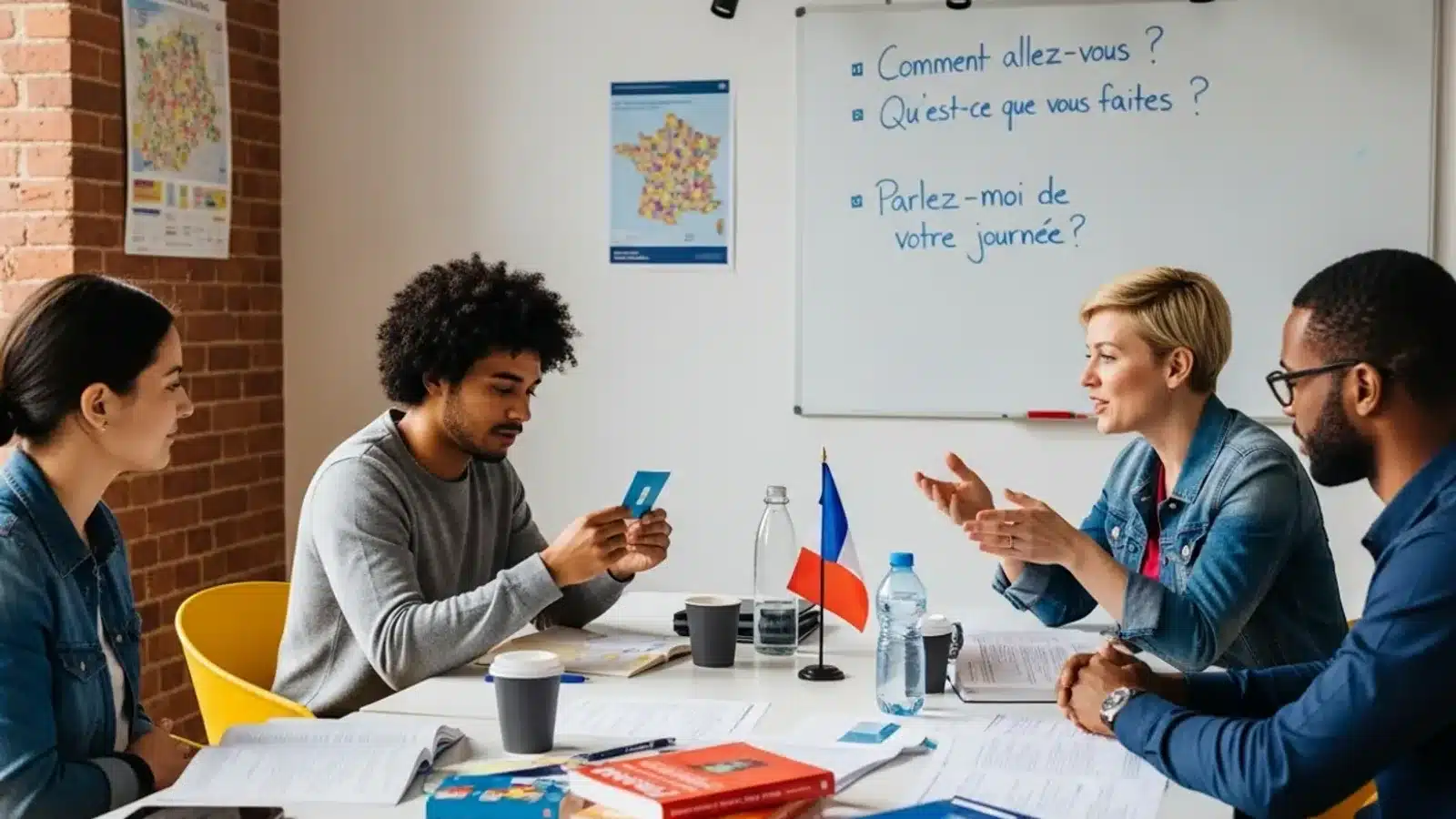
The students who progress fastest aren’t the ones who study hardest — they’re the ones who build French into their daily lives. Here’s how to create a French immersion experience without leaving Vancouver.
The average Vancouver commuter spends 30–45 minutes each way getting to work. That’s 5–7 hours per week of potential French immersion. Switch your podcast feed to French:
This sounds small but it’s surprisingly effective. Change your phone language to French and you’ll encounter hundreds of French words daily — *paramètres* (settings), *rechercher* (search), *supprimer* (delete). After a week, you won’t even notice it anymore. After a month, you’ll have absorbed dozens of vocabulary words without studying. Also switch your social media feeds — follow French accounts on Instagram, subscribe to French YouTube channels, set Google News to French. The more French your digital environment, the faster your brain adapts.
Switch your Netflix audio to French with English subtitles (beginner) or French subtitles (intermediate). Start with shows originally made in French for the most natural dialogue:
The subtitle progression that works: Start with French audio + English subtitles. After 2–3 weeks, switch to French audio + French subtitles. Eventually, turn subtitles off entirely. Most students make this full transition in about 2 months — and the improvement in listening comprehension is dramatic.
Vancouver has several French-owned businesses where staff speak French. Practice ordering in French at:
These micro-interactions might seem tiny, but they build confidence faster than any textbook. There’s something powerful about realizing you can function in French in the real world — it shifts your mindset from “I’m studying a language” to “I’m becoming bilingual.” The first time you successfully order an entire meal in French, something clicks — it stops being a classroom exercise and becomes a real skill you can use.
What Level Do You Need to Start Practicing?One of the biggest fears beginners have is showing up to a conversation group and understanding nothing. Let’s be honest — if you’re A0 (absolute zero), a full-immersion meetup isn’t the right first step. But that doesn’t mean you can’t start practicing immediately.
Here’s what works at each level:
The most important thing at any level is starting. You don’t need to “be ready” to practice — practicing is how you get ready. Our students who combine classes with even 30 minutes of daily immersion progress measurably faster than those who only study in the classroom.
French Cultural Events in VancouverImmersion isn’t just about studying — it’s about connecting with French culture in a way that makes you want to keep learning. Vancouver’s Francophone community hosts events year-round:
 Are Free Practice Methods Enough to Reach CLB 7?
Here’s the thing about conversation groups and self-study — they’re excellent supplements, but they can’t replace structured instruction if you have a specific goal. We see this pattern constantly: students spend 6 months in conversation groups and feel conversational, then take a practice TEF and score CLB 4–5. The gap between “I can chat in French” and “I can pass the TEF at CLB 7” is real, and it’s a gap that requires targeted instruction to close. If you’re preparing for the TEF/TCF exam, need to reach a specific CLB level, or want to progress from beginner to conversational in a defined timeline, you need a program with curriculum, teacher feedback, and accountability.
What most people don’t realize is that free resources plateau at around A2–B1 level. Getting past that plateau — where you can debate, write structured arguments, and understand fast native speech — requires targeted instruction from teachers who understand where you’re stuck and why.
“I not only learn the language but also a lot about French culture and the nuances between casual and professional language use.” — Arush, Vancouver ⭐⭐⭐⭐⭐
At Learn French in Vancouver, our classes are taught by native French teachers from France and Quebec — real conversation partners who correct your pronunciation, grammar, and fluency in real time. Two classes per week, 90 minutes each, in-person in our Gastown classroom or online via Zoom.
The fastest French learners in Vancouver use this exact formula:
| Activity | Hours/Week | What It Builds |
|---|---|---|
| Structured classes | 3 hours | Grammar, vocabulary, exam skills, teacher feedback |
| Conversation group | 1–2 hours | Fluency, confidence, real-world listening |
| French podcasts/media | 3–5 hours | Listening comprehension, accent exposure |
| Self-study (grammar/vocab) | 3–5 hours | Foundation knowledge, writing practice |
| Total | 10–15 hours | All four skills, balanced development |
This combination — structured classes as the backbone, free practice as the accelerator — is how our students consistently reach CLB 7 in 10–12 months from zero. The classes give you the framework; the immersion activities give you the hours.
If you’re preparing for the TEF or TCF specifically, our 12-month TEF for Beginners program or TEF/TCF Prep for intermediate students are designed around exactly this balanced approach.
What Are the Best Online Resources to Practice French?Not everything has to be in person. Some of the best French practice happens at home — especially for skills like listening and reading. Here are resources our students swear by:

Frequently Asked Questions—
The best way to learn French isn’t choosing between classes and immersion — it’s combining both. Vancouver gives you more opportunities to practice French than almost any city outside Quebec. Take advantage of them.
Text or WhatsApp us at +1-778-800-5592 to find the right class for your level, or browse our French classes in Vancouver to see all program options.
300+ reviews at 5.0 stars — by the Learn French in Vancouver team.