

A TEF Canada sample test is the single most effective confidence tool an exam candidate has: nothing calms test-day nerves like already knowing exactly what's ahead of you. Whether you're applying for Permanent Residency, a study or work permit, or Canadian citizenship, the TEF Canada is a key step in proving your French proficiency.
This is our original walkthrough, kept intact and expanded: what the exam includes, the structure of each section with the real question counts and timings, how scores convert to CLB, and the free sample test download to practice like it's the real thing.
By the end, the exam should feel less like a mystery and more like a format, because that's all it is.
The TEF Canada Exam at a Glance
| Section | Time | Questions/Tasks | Format |
|---|---|---|---|
| Listening | 40 min | 40 questions | Multiple choice, audio played once |
| Reading | 60 min | 40 questions | Multiple choice, varied texts |
| Speaking | 15 min | 2 tasks | Live role-play with examiner |
| Writing | 60 min | 2 tasks | Article continuation + letter |
A sample test walks you through this exact structure at practice pace: the same sections, the same timings, the same task shapes you'll meet on exam day.
What Is the TEF Canada?
The TEF Canada (Test d'Évaluation de Français) is one of only two French exams accepted by IRCC for immigration purposes, the other being TCF Canada. It measures your ability to understand and use French in everyday contexts across four skills:
- Listening (Compréhension orale)
- Reading (Compréhension écrite)
- Speaking (Expression orale)
- Writing (Expression écrite)
You take all four sections on the same day, and results are valid for 2 years: plan your exam date so the scores are still fresh when your application goes in, with room for processing.
Not sure whether the TEF is even your exam? Our TEF vs TCF comparison settles that question first. The two are interchangeable for immigration, different in format.
What Does the TEF Canada Sample Test Cover?
Listening: 40 minutes, 40 questions
Real-life audio scenarios: conversations, announcements, interviews, with accents from both Quebec and France, played once, one correct answer per multiple-choice question. This is the section where daily authentic listening pays its dividend, because the exam's audio sounds exactly like the podcasts and radio you've been living with.
The tips that earn points:
- Always answer. There's no penalty for wrong answers. A blank is the only certain zero.
- Read the questions before the audio starts: knowing what to listen for is half the answer.
- Don't chase a missed question. Focus on keywords, let it go, and be ready for the next item.
Reading: 60 minutes, 40 questions
Text types run from ads and formal letters to press articles and visuals, four options per question, one correct. The variety is deliberate, the exam wants proof you can read the French of daily life, not just textbook passages.
- Read the question and options before the passage: then read with a purpose.
- Skim for main ideas first, then return for details the questions actually ask about.
- Manage the clock. Sixty minutes for forty questions leaves no budget for getting stuck; flag and move.
Speaking: 15 minutes, 2 tasks
The section candidates fear most, and the most predictable once you know it:
- Task 1: ask around 10 questions about an informational ad, using formal vous: you're gathering information.
- Task 2: convince a friend about something, using informal tu: you're persuading.
Practice asking and answering aloud, aim for clarity and natural tone, and don't memorize scripts: examiners hear them instantly and mark accordingly. Structured spontaneity is the goal, and it's entirely trainable through role-play repetition.
Writing: 60 minutes, 2 tasks
- Task 1: continue a short news article (80–150 words): add new information, don't recycle the prompt.
- Task 2: write an argumentative letter (200+ words): position, arguments, conclusion.
Use clear paragraph structure and linking words, and leave five minutes to review grammar and spelling: corrected errors cost nothing; uncorrected ones cost points. The letter's argumentative structure can be practiced until it assembles itself, which is exactly what preparation courses drill.
What Was Aurélie's Advice on the TEF?
Our team has walked thousands of candidates through this exam, and the advice that repeats in every information session comes down to three points:
The exam measures preparation as much as French. Two candidates with identical French can land a CLB level apart based purely on format familiarity and timing discipline. That's unfair in the abstract and wonderful in practice, because preparation is entirely within your control.
The speaking tasks reward interaction, not monologue. Ask real questions in Task 1, react to the pushback in Task 2. Candidates who treat it as a conversation consistently outperform candidates who deliver speeches.
Book from evidence. The exam fee is significant and the calendar pressure of a PR application is real: sit the sample tests, watch the trend across them, and book only when the numbers say you're ready.
How Do TEF Scores Convert to CLB?
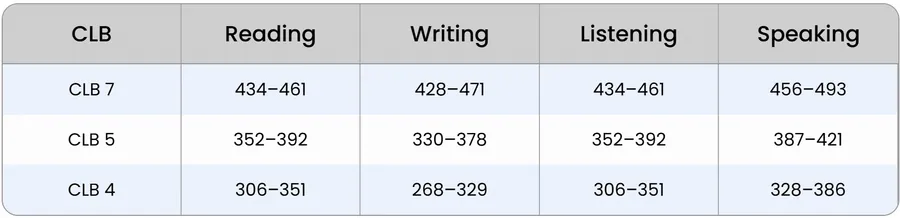
IRCC converts your TEF Canada section scores into Canadian Language Benchmarks (CLB), and your pathway sets the CLB you need: CLB 7 for the big Express Entry French points, CLB 5 for Francophone Mobility, CLB 4 for citizenship.
The conversion chart above shows the full mapping; IRCC's official equivalency charts are the authoritative version. The rule to internalize: CLB is computed per skill, so your weakest section sets your level.
That's exactly why sample tests matter. They tell you which section is your weakest while the fix is still cheap.
How Should You Use a Sample Test?
A sample test used well is a diagnostic; used badly, it's just a worksheet. The method:
- Sit it under real conditions. Full timing, no dictionary, no pauses, phone in another room. The point is meeting the pressure, not just the questions.
- Score it honestly against the answer key, section by section.
- Diagnose before you drill. A low listening score caused by accent trouble needs different work than one caused by vocabulary gaps, same number, different fix.
- Repeat monthly. The trend across sample tests, not any single score, tells you when you're ready to book the real exam.
- Rehearse the furniture. Answer sheets, question phrasing, task order: familiarity here frees attention for French on the day.
Candidates who walk in having sat three full practice runs describe the real exam with one word: familiar. That feeling of familiarity is worth actual points in the first ten nervous minutes.
From Sample Test to Real Test: The Bridge
Between your first practice run and the real booking sits the preparation that converts scores. The sequence that works:
- Weeks 1–2: first full sample test: baseline scores per section, no judgment attached.
- Following months: targeted work on the weakest sections, with feedback on speaking and writing from a teacher who knows the grid.
- Monthly: another timed sample test; watch the trend, not the single result.
- When the trend holds at target: book the real exam roughly four to six weeks out, and shift to full mock exams at real pace.
- Final week: no new material: rehearse formats, sleep, and let the preparation be enough. It will be.
What If Your Sample Test Score Is Below Target?
Good news: that's the sample test doing its job: better to discover the gap in your living room, for free, than at the test centre for the full exam fee.
If you're one CLB level short: targeted section work for 6–12 weeks usually closes it. Focus on your weakest skill; the strongest ones maintain themselves.
If you're several levels short: the gap is language, not technique. Step back to foundation building. Our guide to realistic French timelines maps how long each distance honestly takes, and the full TEF preparation roadmap sequences the stages.
If speaking or writing is the gap: those sections don't improve from more sample tests alone. They need feedback. This is precisely where teachers who know the marking grid change outcomes.
Practice with Purpose: Our TEF Canada Programs
Sample tests show you the mountain; the programs are how you climb it. The TEF/TCF preparation program turns the diagnostic into a plan: live classes with native French teachers from France and Quebec, mock exams scored against the real criteria, and section-by-section strategy. Complete beginners start with the French Transformation program, the 6-month foundation stage that comes before exam prep makes sense.
Learn French in Vancouver has taught 4,500+ students since 2017, in Vancouver and online across Canada, and TEF candidates are the biggest cohort among them. The sample test is where most of their journeys started.
"Bonjour! I would like to thank Noelie and the Learn French team for making it possible for me to get the sufficient result of TEF exam. The profound teaching of the clé grammar end mocking tests - that is the path :)"