

The TEF vs TCF question comes up in almost every consultation we run. If you need to prove your French for Canadian Permanent Residency, through Express Entry, Quebec immigration, a Provincial Nominee Program, or a citizenship application, IRCC accepts exactly 2 French exams. At some point you must choose one.
Both are valid, recognized, and widely available, and both convert to the same CLB levels. Yet they differ in structure, scoring, and, in our students' words, feel. We prepare candidates for both at Learn French in Vancouver, and this guide is the comparison we walk them through.
Some of our students prefer the TEF's structure; others say the TCF feels friendlier. By the end of this guide, you'll know which group you're in, and what to do next.
Why Does the Choice Matter at All?
Because knowing your exam's format is worth real points on either exam. The last CLB level rarely comes from more French. It comes from knowing the exam format so well that all your attention goes to the language, not the instructions.
So the TEF-or-TCF decision is not a small one. It decides what you practice in your final months, which sample materials you buy, and what your mock exams look like. Choose once, early, and every practice session builds toward the same exam day.
A "wrong" choice costs little if you make it early, and a lot if you make it late. Switching exams 2 months before test day resets your format training to zero.
What Are the TEF and TCF?
TEF Canada (Test d'Évaluation de Français) is created by the CCI Paris, the Paris Chamber of Commerce and Industry. They have run the exam since it began. It measures listening, reading, speaking, and writing on a numeric scale that maps to CLB levels. It's accepted by Express Entry, Quebec immigration, PNPs, and IRCC's French-speaking streams.
TCF Canada (Test de Connaissance du Français) comes from France Éducation International, part of the French Ministry of National Education. It tests the same 4 skills and is equally accepted by IRCC. Unlike the general TCF versions, TCF Canada is built specifically for immigration.
The short answer: for immigration value, the exams are interchangeable. The differences live in the details below, and those details decide which exam will feel better on test day.
TEF vs TCF: The Key Differences
| Feature | TEF Canada | TCF Canada |
|---|---|---|
| Created by | CCI Paris | France Éducation International |
| Accepted by IRCC | Yes | Yes |
| Skills tested | All four | All four |
| Listening | 40 min, 40 questions | ~35 min, 39 questions |
| Reading | 60 min, 40 questions | 60 min, 39 questions |
| Speaking | 15 min, 2 role-play tasks | ~12 min, 3 tasks |
| Writing | 60 min, 2 tasks | 60 min, 3 tasks |
| Scoring style | Numeric scale → CLB | Numeric + band scores → CLB |
| Personality | Structured, predictable | More varied, MCQ-heavy |
Our teachers sum it up like this: the TEF is a role-play exam; the TCF is a question exam. TEF speaking asks you to act: question a landlord about an ad, persuade a hesitant friend. The TCF leans on multiple choice, with shorter and more numerous speaking and writing tasks.
Which Exam Is Easier?
The honest answer: neither. They're calibrated to the same CLB outcomes. But one will be easier for you, and it comes down to test-taking style:
- Choose the TEF if you like structure. Its tasks are famously predictable: the 2 speaking scenarios, the 2 writing formats, year after year. If you prepare well, you perform well. That rewards methodical candidates who practice.
- Choose the TCF if role-plays make you freeze. Its heavier multiple-choice weighting and shorter speaking tasks suit strong readers and listeners who would rather answer questions than act out scenes.
- Strong at exams generally? Take the sample tests for both, compare your section scores, and let the results decide. They predict better than preference does.
Some months, one practical factor beats style: session availability. Both exams run regularly in major Canadian cities, but dates fill up. Sometimes the right exam is simply the one you can book inside your timeline.
Still undecided? Good news: the French behind both exams is identical, so no preparation time is wasted while you decide. Foundation work transfers completely between the two. Only the final months of format practice are exam-specific.
What CLB Level Do You Need?
Your target CLB depends entirely on your immigration pathway:
| Pathway | CLB target |
|---|---|
| Express Entry French bonus points (with English CLB 5+) | CLB 7 in all four skills |
| French-language category draws | CLB 7 |
| Francophone Mobility work permits | CLB 5 |
| Citizenship language requirement | CLB 4 |
CLB 7 is the number most PR candidates chase. It can earn you up to 50 additional CRS points plus category-draw eligibility, on top of second-language points. For what those numbers mean in practice, our guide on whether learning French is worth it for PR runs the full math.
Set your target before you choose the exam. Preparing for CLB 5 and preparing for CLB 7 differ more than the TEF and TCF differ from each other.
How Do the Scores Convert to CLB?
Both exams publish official conversion charts. Here are the originals we've always shared with our own students:
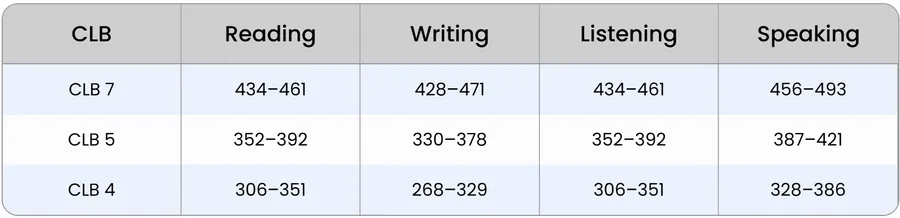
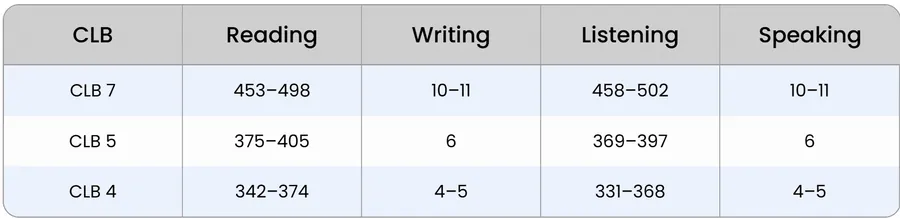
The row to memorize is CLB 7. On the TEF, that's 249-279 in listening and 207-232 in reading, with 310-348 in speaking and in writing. On the TCF, it's 458-502 in listening, 453-498 in reading, and band 10-11 in speaking and writing. Check IRCC's official language-test equivalency charts when you plan. The charts are the law; this paragraph is just the map.
Remember the hard rule: your CLB is set per skill, and pathway requirements apply to every single skill. A brilliant listening score cannot rescue a writing section that falls one point short.
What Do the Exam Days Look Like?
TEF Canada: 4 sections, usually in one sitting, several hours with administration. The speaking section is a 15-minute, 2-part conversation with an examiner. First you gather information using formal vous, then you persuade using informal tu. Writing asks you to continue a news article and to write a letter defending a position, both under time pressure.
TCF Canada: the multiple-choice sections move fast: 39 listening and 39 reading questions. Then come 3 speaking tasks of increasing difficulty, and 3 writing tasks that build from a short message to an argued essay.
Candidates often describe the difference like this: the TEF felt like a performance they had rehearsed; the TCF felt like a very long, very focused quiz. Neither is a complaint. Both are clues about fit, and your sample tests will tell you which one fits you.
Both exams play their audio once, at native speed, with mixed France-and-Quebec accents. Both reward candidates who have practiced the exact format until it feels boring. That is exactly what mock exams are for.
How Should You Prepare for Either Exam?
The preparation is 90% shared between the two exams, which is why our TEF/TCF preparation program covers both: build the French first, then aim it at your chosen format with mock exams, personalized feedback on speaking and writing, and timing strategy. From B1, plan 3 months for a CLB 4-5 target or 6 months for CLB 7. If you're starting from zero, the French Transformation program builds the 6-month foundation that comes first.
Two habits matter no matter which exam you pick: listen to real French daily, in both accents, and get feedback on your speaking and writing from native French teachers who know the marking grids in detail. The full stage-by-stage roadmap lives in our TEF Canada preparation guide.
Learn French in Vancouver has taught 4,500+ students since 2017, preparing candidates for both exams every week, in Vancouver and online across Canada. The teachers marking your mock speaking task tomorrow prepared someone for the same exam last week.
"I´m enrolled in a one year transformation course from level 0 to TEF/TCF exam. The course is well structured and giving you a lot of information. It goes without saying that there´s a lot of self-study needed outside of the course, however, you can always ask for a help from your teacher or study group. I spent my first 6 months of the course with Frédérique and I´m so grateful for everything I learnt in her classes."
Final Thoughts: TEF or TCF for Canadian PR?
If you like predictable structure and don't mind role-play, book the TEF. If multiple choice and shorter speaking tasks sound kinder to your nerves, book the TCF. If you truly can't decide, let your sample-test section scores decide for you. Then commit early and prepare for that exam's exact format, because format familiarity is where the final CLB level is found.
One last thought if you're stuck on this choice: you're choosing between 2 doors into the same room. The French behind them is the real work, and it's the same French either way.
Whichever you choose, the destination is the same: a score report IRCC accepts, the CLB level your pathway needs, and the French itself, which stays with you long after the application.