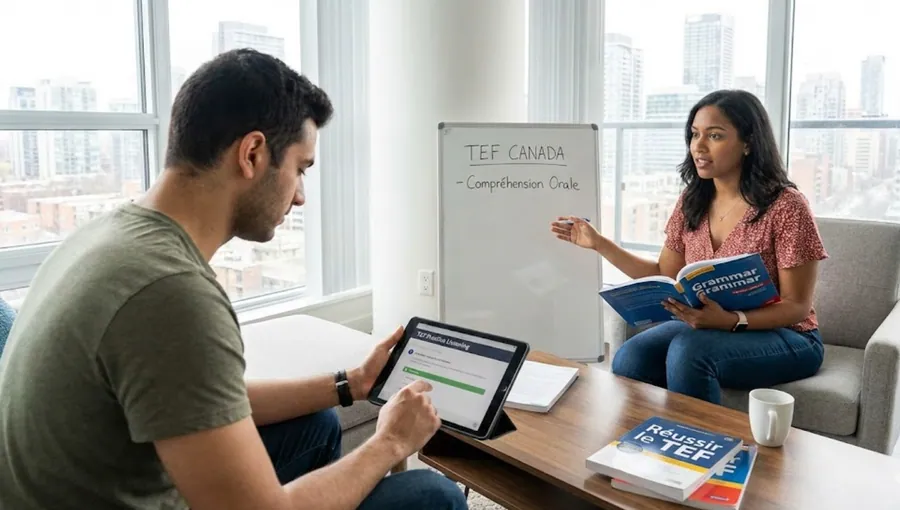
If you’re preparing for the TEF TCF expression orale, the speaking test is probably the part that worries you most. You’re not alone. Of all 4 sections, speaking is the one candidates find most stressful, and the one where preparation makes the biggest difference.
Whether you’re taking the TEF Canada or the TCF Canada, the goal is the same: prove you can communicate clearly and confidently in French. The formats are different, but the skills overlap more than you’d think.
At Learn French in Vancouver, we’ve helped over 4,500 students prepare for both exams. This guide breaks down exactly what you need to know, whether you’re already intermediate or just starting French.
Not sure which exam to take? Check out our TEF vs TCF comparison first.
TEF Expression Orale Format: Sections A and B
The TEF Canada speaking test lasts approximately 15 minutes and has two distinct sections.
Section A: The Information-Gathering Role Play (5 minutes)
You’re given a real-life scenario: renting an apartment, enrolling in a course, or asking about a service. Your job is to ask relevant questions to gather information from the examiner.
You get 1 minute of preparation time to read the prompt.
Key point: Nobody asks for your opinion here. Your job is to ask clear, well-formed questions in French, using “vous” throughout.
Section B: The Persuasive Argument (10 minutes)
You’re given a topic and asked to express and defend your point of view with structured reasoning, examples, and a conclusion.
You get 1 minute of preparation time again.
Key point: The examiner will push back on your arguments. This is normal, and it isn’t a trick. It tests how well you can respond in the moment.
I want Access to the free TEF & TCF sample tests
TCF Expression Orale Format: 3 Tasks in 12 Minutes
The TCF Canada speaking section is structured differently: 3 tasks of increasing difficulty over 12 minutes, with no preparation time.
Task 1, Guided Interview (2 min): The examiner asks personal questions about your background, hobbies, and work. It feels like a warm-up, but the examiner is already scoring your fluency from your first sentence.
Task 2, Interaction (3.5 min): You’re placed in a situation where you need to negotiate or resolve a problem. You’ll need to explain, listen, and adapt, just like in a real conversation.
Task 3, Express an Opinion (4.5 min): The hardest task. Present a clear opinion on an abstract topic with arguments, then defend it when the examiner pushes back. Very similar to TEF Section B, but shorter and with zero prep time.
TEF vs TCF Speaking: Key Differences
| TEF | TCF | |
|---|---|---|
| Duration | ~15 minutes | ~12 minutes |
| Tasks | 2 sections (A + B) | 3 tasks |
| Prep time | 1 minute per section | No prep time |
| Format | Role play + argument | Interview + interaction + opinion |
| Difficulty curve | Section B is significantly harder | Tasks get progressively harder |
The good news? The core skills are identical. Preparing for one prepares you for both.
What the Speaking Exams Actually Look Like
TEF Section A Example: Renting an Apartment
> Your prompt: You see an ad for a furnished apartment in downtown Montreal. You call the landlord for more information.
After your 1-minute prep, you’d ask things like:
- “Bonjour, j’appelle au sujet de l’appartement. Est-ce qu’il est toujours disponible ?”
- “Quel est le loyer mensuel, charges comprises ?”
- “Quelle est la durée minimale du bail ?”
- “Le quartier est-il bien desservi par les transports en commun ?”
The key: Examiners care about variety more than quantity. Ask about price, location, lease terms, and amenities. Show them you can hold a real conversation.
TEF Section B Example: Convincing a Friend
> Your prompt: You discovered an outdoor fitness class. Present it to your friend and convince them to join.
A B2+ response follows a clear arc:
- Open: “J’ai découvert quelque chose de génial : un cours de fitness en plein air près de chez nous.”
- Argue: “D’abord, c’est une excellente façon de rester en forme. En plus, c’est en groupe, donc c’est plus motivant que la salle de sport.”
- Handle pushback: “Justement, le cours ne dure qu’une heure, deux fois par semaine. Et c’est le matin, avant le travail.”
- Close: “On n’a rien à perdre. Le premier cours est gratuit : on essaie samedi ?”
What makes this B2+: Linking words (d’abord, en plus, justement), handling objections directly, and closing with a concrete next step.
Free Practice Resources: See What the Exam Looks Like
Want to see what the speaking exam actually looks like? We’ve put together a free resource page with:
- 2 full-length mock exam videos: watch one of our teachers work 1-on-1 with a real student through the TEF and TCF speaking sections, exactly like a private class
- Practice tests for all 4 sections: Reading, Listening, Speaking, and Writing, with answer keys
I want Access to the free TEF & TCF sample tests
Scoring Criteria: What Examiners Actually Look For
Both the TEF and TCF evaluate your speaking across the same core dimensions:
Relevance and Clarity. Are you answering the prompt? Under pressure, many candidates go off-topic. Stay focused.
Structure and Coherence. Can you organize your thoughts logically? Use linking words: d’abord, ensuite, par ailleurs, en conclusion. Examiners love clear structure.
Vocabulary and Grammar. You don’t need perfect grammar. You need varied and appropriate language. Using the same 3 verbs again and again hurts more than an occasional conjugation slip.
Pronunciation and Fluency. Fluency doesn’t mean speaking fast. It means speaking smoothly, without long pauses. A slight accent is perfectly fine.
The target: For most immigration programs, you need NCLC 7 or higher. For the TEF, that’s a raw score of approximately 393+. For the TCF, you need level B2 or higher, which converts to NCLC 7+.
Common Mistakes That Cost You CLB Levels
After coaching thousands of candidates, our teachers see the same patterns. Avoid these and you’re already ahead.
Memorizing Scripts
This is the biggest trap. Examiners spot memorized answers instantly. Learn flexible frameworks, not word-for-word scripts. Memorizing costs you the most on the TCF, where you get no prep time.
Ultra-Short Answers
Short answers don’t give examiners enough to evaluate. Develop each point with examples and follow-ups.
Wasting the Preparation Minute (TEF)
That one minute matters a lot. Candidates who write down 3-4 key points consistently do better than those who stare at the prompt.
Not Warming Up (TCF)
Since the TCF gives you no prep time, warm up your French before you walk in. Listen to a podcast, talk to yourself in French on the way there.
Freezing After a Mistake
The mistake itself is not the problem. The 10-second freeze that follows is. Correct yourself briefly and move on. Saying “il a allé... pardon, il est allé” actually shows the examiner you know the rule.
Practice Strategies That Actually Work
Build a Daily Speaking Habit
You can’t cram for a speaking test. Your brain needs practice retrieving vocabulary in real time.
- Record yourself daily responding to a random topic for 2-3 minutes. Listen back and pick one thing to improve.
- Shadow French podcasts. Pause after each sentence and repeat it, copying the intonation.
- Think in French. Narrate daily activities: Je prépare mon café. Ensuite, je vais vérifier mes courriels.
Master Linking Words
The difference between B1 and B2 is often structural. B2 speakers connect their ideas:
- Adding: de plus, en outre, par ailleurs
- Contrasting: cependant, néanmoins, en revanche
- Concluding: en somme, pour conclure, en définitive
Simulate Real Exam Conditions
Set a timer and practice under pressure. For the TEF, give yourself 1 minute of prep then speak for the full duration. For the TCF, practice responding immediately to random prompts with zero prep time.
Our TEF/TCF Prep course includes mock oral exams with native French teachers who score you using the actual exam criteria, for both formats.
Have Questions? Connect with Lily
Have questions about the TEF or TCF exam, or about our French courses? Join our next live Q&A session, every Tuesday and Thursday from 6 to 7 PM Vancouver time. Get all your questions answered directly by our experienced instructors.
I want to Register for the next free Masterclass
Hundreds of students have started learning French right here, and it’s completely free.
How We Help You Ace Expression Orale
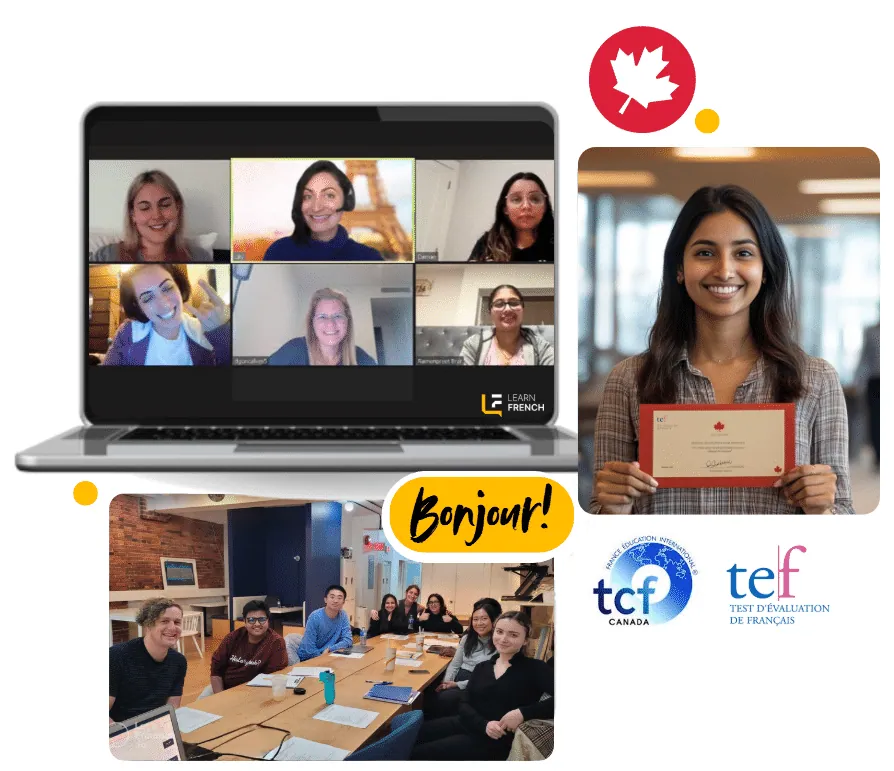
Our TEF/TCF Prep course includes dedicated Expression Orale practice with mock interviews, scored by native French teachers who know exactly what examiners look for.
You’ll run through real exam simulations under timed conditions, get detailed feedback on structure, vocabulary, and pronunciation, and repeat until it feels natural. With 4,500+ students coached, our teachers know what separates a CLB 5 from a CLB 9.
Starting from zero? Our 12-month TEF Beginner program takes you from zero to exam-ready, with small groups of max 14 students.
Frequently Asked Questions
What NCLC score do I need on Expression Orale for Canadian immigration?
Can I use English during the speaking test?
How long should I prepare for the speaking test?
What topics come up in Section B / Task 3?
Your Next Step
The TEF TCF expression orale doesn’t have to hold you back. Learn the format, know what examiners look for, and practice with a plan. Do that and you can go into the exam confident and come out with the NCLC score you need.
Ready to start? Try our free TEF & TCF sample tests to see where you stand today.