

If you’ve searched “DELF vs TEF” or wondered which French exam you actually need for Canada, you’re not alone. There are three major French proficiency exams — DELF, TEF, and TCF — and they serve very different purposes. Choosing the wrong one can cost you months of preparation time and hundreds of dollars in exam fees.
Here’s the short version: if you need French for Canadian permanent residency or citizenship, you need TEF Canada or TCF Canada — not DELF. But the full picture is more nuanced than that, especially if you’re considering Quebec or want a credential that lasts forever.
Let’s break down all three exams so you know exactly which one to register for.
—
 The Three Major French Exams at a Glance
Before we dive deep, here’s the big picture:
| Feature | DELF/DALF | TEF Canada | TCF Canada |
|---|---|---|---|
| Full name | Diplôme d’Études en Langue Française | Test d’Évaluation de Français | Test de Connaissance du Français |
| Type | Diploma (permanent) | Attestation (expires) | Attestation (expires) |
| Validity | Lifetime ♾️ | 2 years | 2 years |
| Administered by | France Éducation internationale | CCI Paris Île-de-France | France Éducation internationale |
| Accepted by IRCC? | ❌ No | ✅ Yes | ✅ Yes |
| Format | Paper-based | Paper-based | Computer-based |
| Approximate cost | $250-$400 CAD | $400-$450 CAD | $350-$400 CAD |
That last row — “Accepted by IRCC?” — is the one that matters most if you’re pursuing Canadian permanent residency through Express Entry, a Provincial Nominee Program, or citizenship. IRCC only accepts TEF Canada and TCF Canada. DELF is not on the list.
Now let’s look at each exam in detail.
—
DELF & DALF: The Permanent French DiplomaDELF stands for Diplôme d’Études en Langue Française, and DALF stands for Diplôme Approfondi de Langue Française. Together, they cover every level of French proficiency from beginner to mastery.
The biggest distinction: DELF/DALF is a diploma, not a test result. Once you earn it, it never expires. You’ll have a permanent French credential recognized by institutions and employers worldwide. TEF and TCF results, by contrast, expire after two years.
DELF covers four levels:
DALF extends into advanced levels:
Each DELF level tests all four language skills:
Total: 100 points. You pass with 50/100 and a minimum of 5/25 in each section. The exam is paper-based, and speaking is face-to-face with an examiner.
Here’s where many people get tripped up: DELF/DALF is NOT accepted by IRCC for Express Entry, PNP, or citizenship applications. If your goal is Canadian permanent residency through any federal immigration program, a DELF diploma — no matter how impressive — won’t count.
There is one important exception: Quebec immigration. If you’re applying through Quebec’s programs (like the Programme de l’expérience québécoise or the Programme régulier des travailleurs qualifiés), a DELF B2 or DALF diploma can satisfy the French language requirement. But for everything else? You need TEF or TCF.

—
TEF Canada: The Primary Immigration ExamTEF stands for Test d’Évaluation de Français and is administered by the CCI Paris Île-de-France (the Paris Chamber of Commerce). TEF Canada is the version specifically designed for Canadian immigration applications.
TEF Canada tests all four language skills, and your scores are converted to CLB levels (Canadian Language Benchmarks) — the standard IRCC uses to evaluate language proficiency. The exam is entirely paper-based.
| Section | Duration | Format |
|---|---|---|
| Compréhension Orale (Listening) | 40 minutes | 60 multiple-choice questions |
| Compréhension Écrite (Reading) | 60 minutes | 50 multiple-choice questions |
| Expression Orale (Speaking) | 15 minutes | 2 tasks, face-to-face with examiner |
| Expression Écrite (Writing) | 60 minutes | 2 written tasks |
Key advantage: TEF Canada is the most widely available French exam in Canada, with test centers in major cities including Vancouver, Toronto, Calgary, and Edmonton. It’s also the exam most immigration consultants are familiar with, which can simplify your application process.
Another practical benefit: TEF gives you more time for listening (40 minutes for 60 questions) compared to TCF (35 minutes for 39 questions). Students who find listening to be their weakest skill often appreciate those extra minutes. The writing section also gives you two tasks rather than three, allowing more time to structure your responses carefully.
TEF scores map directly to CLB levels, and IRCC has a published conversion table that your immigration consultant or lawyer will use to verify your results. There’s no ambiguity — your score either meets the CLB threshold or it doesn’t.
For a deeper look at what TEF Canada looks like in practice, our TEF Canada sample test guide includes free practice questions for every section.
—
TCF Canada: The Computer-Based AlternativeTCF stands for Test de Connaissance du Français and is administered by France Éducation internationale — the same organization behind DELF/DALF. TCF Canada is the version accepted by IRCC.
The biggest practical difference? TCF Canada is computer-based for the listening and reading sections. If you’re comfortable with computers and prefer clicking answers over filling in bubbles on paper, TCF may feel more natural.
| Section | Duration | Format |
|---|---|---|
| Compréhension Orale (Listening) | 35 minutes | 39 questions, computer-based |
| Compréhension Écrite (Reading) | 60 minutes | 39 questions, computer-based |
| Expression Orale (Speaking) | 12 minutes | 3 tasks, face-to-face with examiner |
| Expression Écrite (Writing) | 60 minutes | 3 written tasks |
One thing students often ask: “Is TCF easier than TEF?” The honest answer is that neither exam is objectively easier — they test the same skills at the same levels. But students tend to have preferences based on format. If you’re a stronger reader who benefits from having text on screen, TCF may suit you. If you prefer paper and pencil and want more time for listening (40 minutes vs 35), TEF could be the better fit.
For a detailed comparison of just these two exams, check our TEF vs TCF comparison guide.
—
Which French Exam Do You Actually Need?This is the question that matters. Your goal determines your exam. Here’s a clear decision framework:
You need: TEF Canada or TCF Canada.
IRCC accepts only these two exams. Your scores will be converted to CLB levels, and those CLB levels directly translate into CRS points for your Express Entry profile.
Here’s what the points look like:
What most people don’t realize is that the French bilingual bonus stacks with your English scores. If you already have high IELTS scores and add CLB 7 French, you could be looking at nearly 100 extra CRS points combined. That’s often the difference between receiving an Invitation to Apply and waiting indefinitely.
DELF cannot be submitted with your Express Entry profile — even a DELF B2 diploma won’t count. This catches many candidates off guard, especially those who earned DELF in their home country and assumed it would work.
You need: TEF Canada or TCF Canada at CLB 4 minimum.
CLB 4 is significantly lower than CLB 7 — most students can reach this level in about 6 months of structured learning. Again, DELF is not accepted for citizenship applications.
You can use: TEF Québec (TEFAQ), TCF Québec, OR DELF B2/DALF.
This is the one scenario where DELF shines for immigration purposes. Quebec’s provincial programs accept DELF B2 and DALF as proof of French proficiency. If you’re specifically targeting Quebec and want a permanent credential that never expires, DELF B2 is worth considering.
However, keep in mind: if your plans change and you later apply through federal Express Entry instead of a Quebec program, your DELF diploma won’t transfer. TEF or TCF keeps your options open.
DELF/DALF is the strongest choice.
If you’re applying to a French-language university, seeking a teaching credential, or want a permanent résumé credential, DELF B2 or DALF C1 carries the most weight. It’s recognized by educational institutions in 175+ countries and never needs to be renewed.
—
DELF vs TEF vs TCF: The Complete ComparisonHere’s everything side by side so you can make an informed decision:
| Criteria | DELF/DALF | TEF Canada | TCF Canada |
|---|---|---|---|
| Express Entry | ❌ | ✅ | ✅ |
| PNP Programs | ❌ | ✅ | ✅ |
| Citizenship | ❌ | ✅ | ✅ |
| Quebec Immigration | ✅ (B2+) | ✅ (TEFAQ) | ✅ (TCF Québec) |
| Academic recognition | ✅ (175+ countries) | Limited | Limited |
| Validity | Lifetime | 2 years | 2 years |
| Test format | Paper | Paper | Computer + paper |
| Speaking time | ~15 min (B2) | 15 min | 12 min |
| Results timeline | 2-3 months | 3-5 weeks | 3-4 weeks |
| Can you retake? | Yes (full exam) | Yes (full or partial) | Yes (full exam) |
The bottom line: If you’re immigrating to Canada through any federal program, TEF or TCF is your only option. DELF is a great credential to have, but it won’t help your immigration application. The exception is Quebec, where DELF B2+ is accepted.
—
Common Mistakes When Choosing a French ExamAfter helping 4,000+ students navigate this decision, we’ve seen the same mistakes come up again and again:
—
How We Prepare You for TEF and TCFAt Learn French in Vancouver, we prepare students for both TEF Canada and TCF Canada — so you can choose whichever exam suits your strengths. Most schools only prepare for one. We believe giving you options is better than forcing you into a single path.
Here’s how our programs align with exam goals:
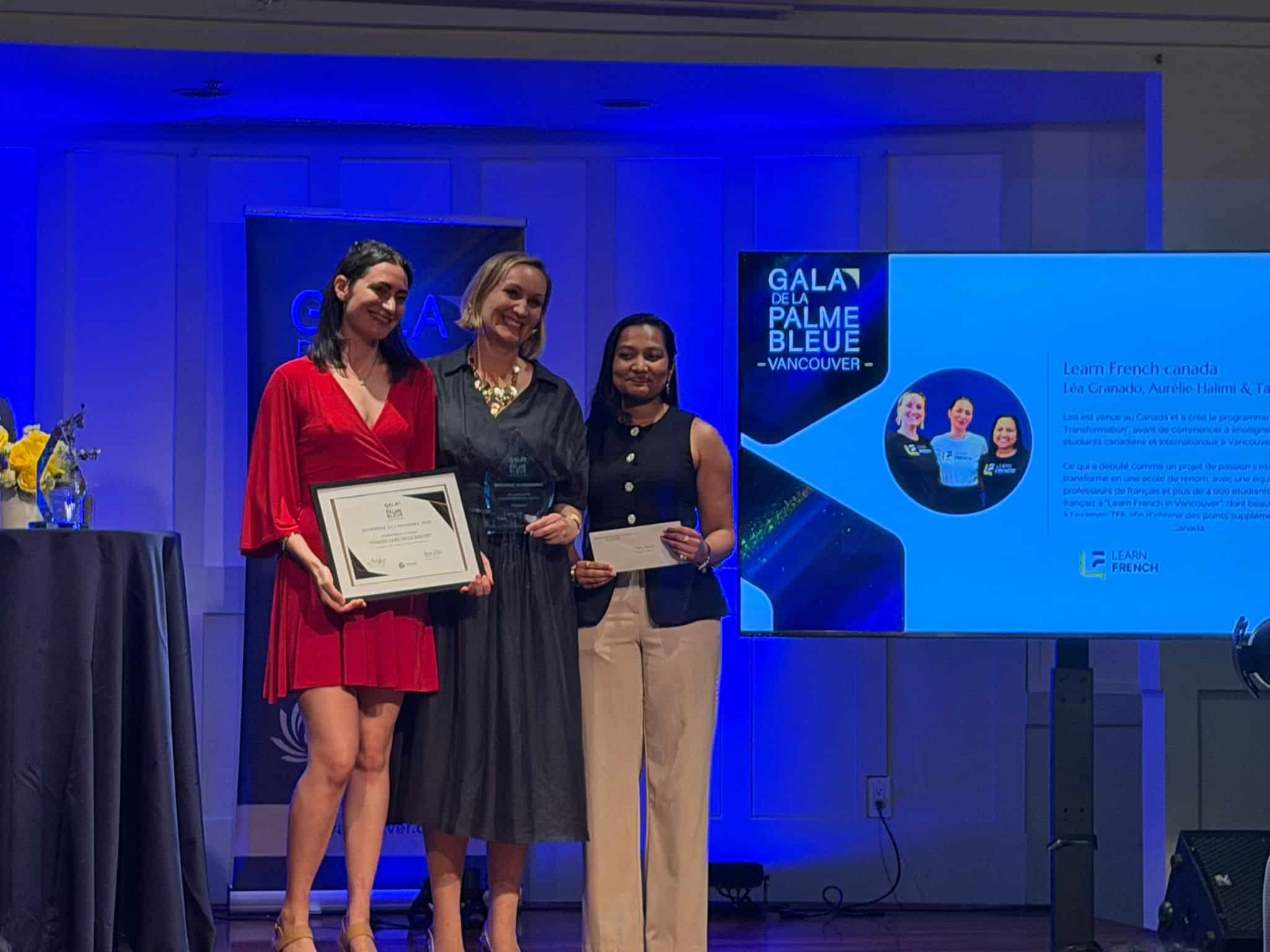
Our 14 native French teachers from France and Quebec have guided 4,000+ students through this process. 95% pass on their first attempt. That’s not marketing — that’s the result of a system built around exam success, refined over 7+ years and 200+ five-star Google reviews.
Not sure where you stand? Text or WhatsApp us at +1-778-800-5592 to chat about your goals, or explore our complete French exams guide for more details on every test we cover.
—
Frequently Asked Questions