

The most popular French books have a hidden advantage for learners: almost every French person has read them, so every page you finish is a future conversation. You asked us for a reading list. Here it is, kept from our original selection and rebuilt with difficulty ratings and reading tips.
Reading is the most patient teacher you'll ever have. The page never speaks too fast, waits while you look a word up, and repeats itself as many times as you need.
You can find most of these titles at the Vancouver Public Library or through a Francophone book club. Every one of them exists as an affordable paperback or e-book.
Why Read French Books as a Learner?
Reading builds the deep layer of the language: vocabulary in context, grammar by exposure, and spelling by sheer repetition. A learner who reads sees the structures from class working in real sentences.
It also fixes the pace problem. Films and conversations run at the speaker's speed; a book runs at yours. That makes novels the one form of immersion available at every level.
And why these 10? They're shared culture. Mention Le Petit Prince or Monte-Cristo to a French speaker and you step inside the culture that speaks the language.
The 10 French Books at a Glance
| # | Book | Author | Difficulty |
|---|---|---|---|
| 1 | Le Petit Prince | Antoine de Saint-Exupéry | Easy-Intermediate |
| 2 | Le Petit Nicolas | René Goscinny | Easy-Intermediate |
| 3 | L'Étranger | Albert Camus | Intermediate |
| 4 | L'Élégance du hérisson | Muriel Barbery | Intermediate |
| 5 | Le Mystère de la Chambre Jaune | Gaston Leroux | Intermediate |
| 6 | Les Yeux Jaunes des Crocodiles | Katherine Pancol | Intermediate |
| 7 | Le Tour du Monde en 80 Jours | Jules Verne | Intermediate |
| 8 | Le Comte de Monte-Cristo | Alexandre Dumas | Advanced |
| 9 | Vendredi ou la Vie Sauvage | Michel Tournier | Easy-Intermediate |
| 10 | Les Jeux Sont Faits | Jean-Paul Sartre | Intermediate |
The Gentle Classics: Start Here
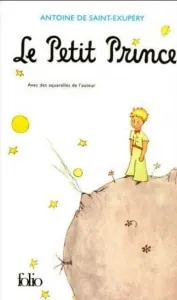
1. Le Petit Prince, by Antoine de Saint-Exupéry
The classic of classics. This slim, illustrated tale has been translated into hundreds of languages and has sold some 200 million copies worldwide. Most French people have read it more than once, because its message about what matters in life reads differently at every age. Saint-Exupéry's own watercolours carry half the story.
"On ne voit bien qu'avec le cœur. L'essentiel est invisible pour les yeux." In English: it is only with the heart that one sees rightly; what is essential is invisible to the eye.
For learners, it's the perfect first novel: short sentences, poetic but simple vocabulary, and a story you may already know in English. Difficulty: Easy-Intermediate.
2. Le Petit Nicolas, by René Goscinny
Published in 1959, this children's classic follows the smallest boy in his class: great friends, loving family, hopeless at math. Through his eyes, adult behaviour becomes gentle comedy. Goscinny wrote it the same year he co-created Astérix, and the comic-strip style shows in every episode-length chapter.
Because the narrator is a child, the vocabulary is the everyday French of school, home, and friendship, exactly what an adult beginner needs first. Difficulty: Easy-Intermediate.
9. Vendredi ou la Vie Sauvage, by Michel Tournier
Tournier's retelling of Robinson Crusoe, written deliberately for younger readers, is a staple of French classrooms. Generations of French students met it in sixième (first year of middle school). A shipwreck, an island, and a friendship that turns the castaway story you think you know upside down, with Vendredi, not Robinson, as the real teacher.
Short chapters and concrete action make it one of the most manageable "real novels" for learners. Difficulty: Easy-Intermediate.
The Intermediate Shelf: Real Literature, Readable French
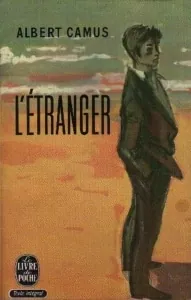
3. L'Étranger, by Albert Camus
Published in 1942 and ranked first in Le Monde's 100 Books of the Century, Camus's novel opens in French Algeria with Meursault learning of his mother's death, and observing his own lack of grief as if from outside.
Here's the learner's secret: the vocabulary is genuinely simple. Camus writes in short, flat, present-tense sentences; the difficulty is in the ideas, not the grammar. Difficulty: Intermediate.
4. L'Élégance du hérisson, by Muriel Barbery
A Parisian apartment building at 7 rue de Grenelle, seen by two hidden geniuses: Renée, the 54-year-old concierge who hides her intelligence behind her job, and Paloma, the rich 12-year-old who hides hers to survive school. Published in 2006 by philosophy teacher Muriel Barbery, it became a worldwide phenomenon.
The alternating narrators give you two registers of French in one book: Renée's formal elegance and Paloma's sharp, modern teenage voice. Difficulty: Intermediate.
5. Le Mystère de la Chambre Jaune, by Gaston Leroux
One of the first locked-room mysteries ever written, serialized in 1907-1908 by the author of The Phantom of the Opera. Young journalist Joseph Rouletabille investigates an impossible attack inside a sealed yellow room.
Mysteries are underrated learning tools: the plot pulls you forward through vocabulary you would never push through otherwise. Its 236 pages tend to disappear in one or two sittings. Difficulty: Intermediate.
6. Les Yeux Jaunes des Crocodiles, by Katherine Pancol
Winner of the 2006 Maison de la Presse award, Pancol's Paris-set bestseller mixes ambition, betrayal, sisterhood, and reinvention. The crocodiles are a metaphor, mostly.
This is contemporary conversational French: the dialogue reads like the France of today, which makes it the most immediately useful novel on this list. Difficulty: Intermediate.
10. Les Jeux Sont Faits, by Jean-Paul Sartre
Sartre's screenplay-novella imagines two strangers who meet after death and are offered a second chance at life, if they can prove they love each other within 24 hours.
Written as a script, it's nearly all dialogue in clean, direct French: philosophy delivered at conversation speed. A French-class staple worldwide. Difficulty: Intermediate.
The Big Adventures: Worth the Climb
7. Le Tour du Monde en 80 Jours, by Jules Verne
Published in 1873: Phileas Fogg bets half his fortune at the Reform Club that he can travel around the world in 80 days, and leaves that same evening with his French valet Passepartout.
Verne's adventure writing is event-driven and concrete: trains, ships, deadlines. That keeps you following the story even when the 19th-century vocabulary stretches you. Difficulty: Intermediate.
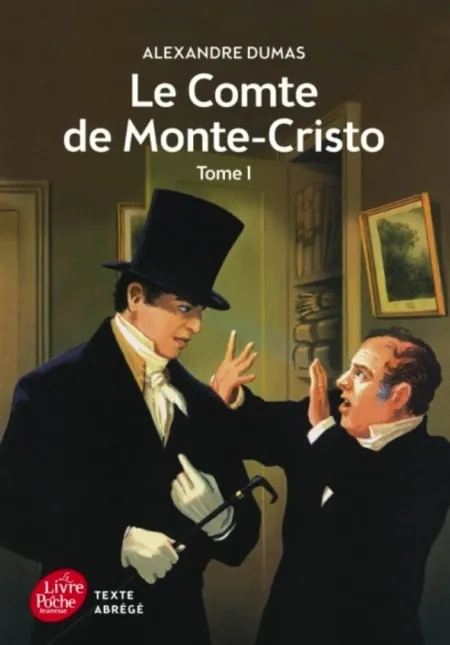
8. Le Comte de Monte-Cristo, by Alexandre Dumas
Serialized between 1844 and 1846: 19-year-old sailor Edmond Dantès is betrayed on the eve of his wedding and imprisoned in the Château d'If. He returns years later: rich, patient, and set on the most satisfying revenge in Western literature.
At roughly 500 pages (and far more unabridged), it's the summit of this list. Read it abridged first if you like; finishing Monte-Cristo in French, in any edition, is a milestone worth bragging about. Difficulty: Advanced.
How Do You Read French Books as a Learner?
The method matters as much as the list:
- Read one level below your ceiling. If you're stopping every sentence to translate, drop to an easier book. Flow teaches more than struggle.
- Look up a word only the third time you meet it. The first and second times, guess from context. The third appearance means it's worth learning.
- Read aloud one page per session. It ties pronunciation to spelling, and French spelling needs the help.
- Pair the book with its film. L'Élégance du hérisson, Monte-Cristo, and Le Petit Prince all have adaptations; our guide to classic French movies makes the double feature a study plan.
- Borrow before you buy. The Vancouver Public Library (opens in a new tab) keeps French shelves that cover most of this list.
Reading with kids? Our companion guide to French books for 10-year-olds shares 2 titles with this list, on purpose. Books the whole family can discuss are books that get finished.
And when a character's phrase puzzles you, it's probably an idiom. Our guide to essential French expressions explains the ones French writers use without thinking.
From Reading French to Speaking It
Here's the honest limit of books: they fill your head with French and leave it there. Speaking is a separate skill. It means finding those words under time pressure, out loud, with a real person, and it's the skill employers, examiners, and in-laws actually hear.
Our classes are built to close that gap. The French Transformation program takes complete beginners to conversational French in 6 months with native French teachers from France and Quebec, max 14 students, so every class makes you use what you've read. Learn French in Vancouver has taught 4,500+ students since 2017, in Vancouver and online across Canada.
Prefer building your base alone before speaking? The Self-Study Course covers our beginner curriculum in videos. It gives your reading habit a structured base to grow from.
"I had a great experience with this French course. The structure of the program is very well organized, which makes it easy to follow and build knowledge step by step. The lessons are engaging and interactive, so it never feels boring or repetitive. Virginie explains grammar clearly and provides practical exercises that really help reinforce what we learn."