

TEF Expression Orale Section B is the speaking role-play where you present a short document, usually an ad, and try to convince the examiner, who plays your friend, to join in. You do well by staying in tu, giving reasons that fit your friend's life, answering every objection and ending with a clear plan.
What is TEF Expression Orale Section B?
Section B is the second task of the TEF Canada speaking test: a role-play in which you persuade the examiner to do something described in a document. The examiner plays someone close to you and pushes back with doubts you have to answer.
The document is short and practical: a flyer for a workshop, an ad for a club, a trip or a volunteer day. You don't read it aloud. You present it in your own words, then argue.
| Part | What happens | Where the detail comes from |
|---|---|---|
| Whole speaking test | 15 minutes, 2 topics | The test owner, CCI Paris Île-de-France (2026) |
| Section A | You ask questions to get information | Candidate reports |
| Section B | You convince a friend using a document | Candidate reports |
| Section B timing | About 1 minute to read, then up to 10 minutes of talk | What students report from the test room |
| Register | tu (informal), because you talk to a friend | The task itself |
The test owner's TEF Canada page lists expression orale (speaking) as 15 minutes with 2 topics, and gives no split between the two parts. Train for a long Section B anyway, so a few extra minutes never catch you out.
If you need the big picture first, start with our TEF speaking test format guide. For the question-asking task right before this one, jump into TEF Section A and how to ask the right questions.
Why Section B matters for your NCLC speaking score
Section B matters because your TEF certificate shows one score per test, and that speaking score converts to an NCLC level with the official correspondence table. Express Entry programs set a minimum NCLC in speaking, so a weak role-play can drop you below the line.
| Express Entry program | French speaking minimum (2026) |
|---|---|
| Federal Skilled Worker | NCLC 7, in all 4 abilities |
| Canadian Experience Class, TEER 0 or 1 job | NCLC 7, in all 4 abilities |
| Canadian Experience Class, TEER 2 or 3 job | NCLC 5, in all 4 abilities |
| Federal Skilled Trades | NCLC 5 in speaking and listening |
IRCC's Express Entry language test page lists these minimums and names TEF Canada and TCF Canada as the approved French tests. Your results must be less than 2 years old when you create your profile and when you submit your PR application.
Strong French (NCLC 7 or higher in all four skills) can also add up to 50 CRS points, 25 or 50 depending on your English results. For a citizenship application you take only two TEF Canada tests, listening and speaking, so speaking is half your exam.
The four moves that win a persuasion role-play
A strong Section B answer follows four moves in order: open, argue, handle pushback, close. The structure keeps you talking for the whole task and gives you somewhere to go when the examiner says no.
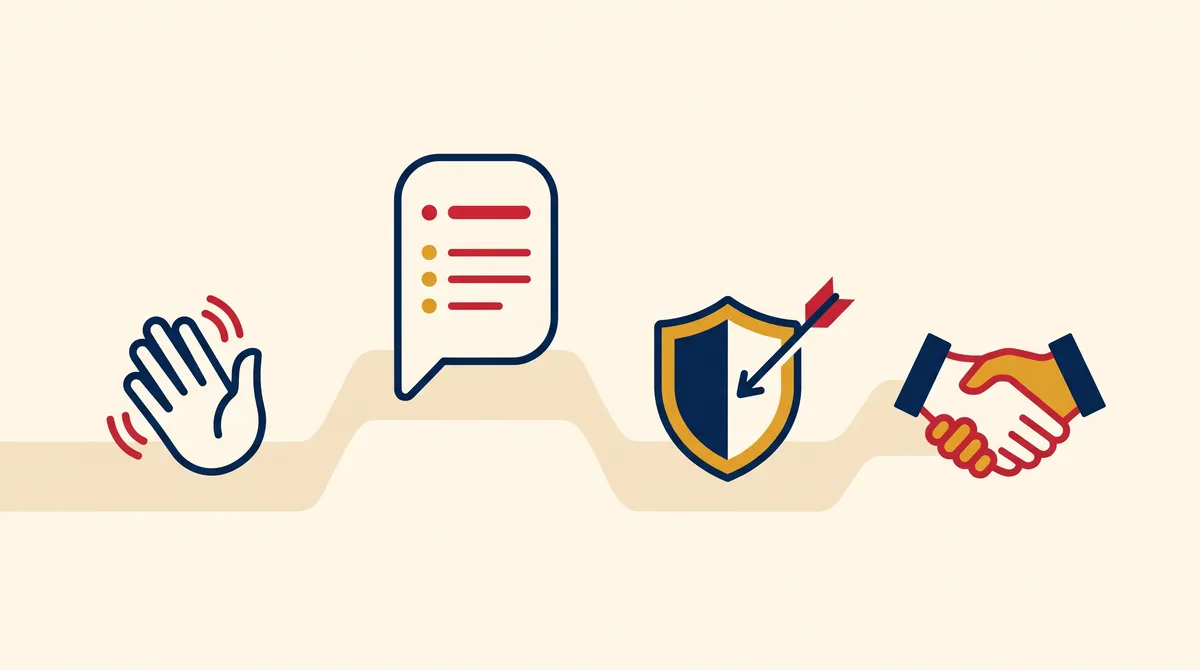
- Open: greet your friend, say why you thought of them, and present the document in two or three sentences.
- Argue: give two or three reasons linked to your friend's life, such as money, health, meeting people or a new skill.
- Handle pushback: for each objection, show you understand, then turn the doubt into a reason.
- Close: ask for a yes, propose a concrete next step and offer to go together.
Pushback is where you spend most of your time. Every doubt the examiner throws at you is an invitation: drop in a linking word, try a conditional like si tu viens, tu verras, and keep the tone warm.
A full model answer in French, with translation
A cooking workshop ad makes a good practice document, and the answer that follows uses all four moves with the examiner's objections in between. Read it aloud once in French, then cover the English and build your own version.
Atelier de cuisine française. Tous les samedis matin, à Vancouver. Ouvert aux débutants. Préparez un menu complet et repartez avec les recettes. Inscription sur notre site.
The ad says: French cooking workshop. Every Saturday morning, in Vancouver. Open to beginners. Cook a full menu and take the recipes home. Sign up on our website.
Open
- Salut ! Tu as deux minutes ? J'ai vu une annonce et j'ai tout de suite pensé à toi. (Hi! Got two minutes? I saw an ad and thought of you right away.)
- C'est un atelier de cuisine française, le samedi matin, ici à Vancouver. (It's a French cooking workshop, on Saturday mornings, here in Vancouver.)
Argue
- Tu me dis toujours que tu en as marre des plats tout prêts. Là, tu apprends à faire un vrai menu, et en plus, tu repars avec les recettes. (You always tell me you're tired of ready-made meals. Here you learn to cook a real menu, and you take the recipes home too.)
- C'est ouvert aux débutants, donc pas besoin d'être un chef. (It's open to beginners, so you don't need to be a chef.)
- Et puis, tu viens d'arriver à Vancouver. Ça te ferait du bien de rencontrer du monde. (And you've just moved to Vancouver. Meeting people would do you good.)
Handle pushback
- Examiner: Le samedi matin ? C'est mon seul jour pour dormir ! (Saturday morning? It's my only day to sleep in!)
- You: Je te comprends, mais justement, ça te donne une raison de te lever. Et l'après-midi, tu es libre. (I get it, but that's the point: it gives you a reason to get up. And your afternoon is free.)
- Examiner: Ça doit coûter cher, non ? (That must be expensive, right?)
- You: Je ne connais pas encore le prix, je vais vérifier sur leur site. Mais pense à tout ce que tu dépenses au restaurant. Si tu sais cuisiner, tu économises. (I don't know the price yet; I'll check their website. But think of everything you spend at restaurants. If you can cook, you save money.)
- Examiner: Je ne connais personne là-bas. (I don't know anyone there.)
- You: Justement, je viens avec toi ! On s'inscrit ensemble, comme ça on se motive. (Exactly, I'll come with you! We sign up together, so we keep each other going.)
Close
- Alors, qu'est-ce que tu en dis ? On essaie un samedi, et si tu n'aimes pas, on arrête. D'accord ? (So, what do you say? We try one Saturday, and if you don't like it, we stop. Deal?)
- Je regarde le site ce soir et je t'envoie le lien. (I'll look at the website tonight and send you the link.)
In the real exam the examiner may resist for longer than this. Keep the same pattern for every new doubt: understand, turn it, add a reason.
What makes this model answer persuasive
The answer works because every reason connects to the friend's life and every objection gets a real reply. CCI Paris does not publish an official Section B grading grid, so treat this table as what actually persuades an examiner, not a legal checklist.
| Move | Example from the model | Why it helps |
|---|---|---|
| Presents, doesn't read | C'est un atelier de cuisine française, le samedi matin | Shows you understood the document and can rephrase it |
| Personal reasons | Tu me dis toujours que tu en as marre… | Sounds like a real friend, not a list of features |
| Accept, then turn | Je te comprends, mais justement… | Answers the doubt instead of ignoring it |
| Honest about gaps | Je ne connais pas encore le prix, je vais vérifier | Avoids inventing facts the document doesn't give |
| Linking words | en plus, et puis, donc, comme ça | Makes the argument easy to follow |
| Concrete close | On essaie un samedi… je t'envoie le lien | Ends the task with a plan, not a shrug |
| Tu all the way | tu, te, toi, ton | The right register for a friend |
Notice the rhythm here. The answer moves back and forth in short turns. A real dialogue like this is much easier to keep alive for ten minutes than a memorized speech.
Useful French phrases for convincing a friend
Six or seven persuasion phrases, said out loud until they come without thinking, will carry you through most Section B tasks. Pick the ones that sound like you and drop the rest.
| Job | French | English |
|---|---|---|
| Start the chat | Tu as deux minutes ? | Got two minutes? |
| Present the idea | J'ai vu une annonce qui va te plaire. | I saw an ad you're going to like. |
| Make it personal | Ça te ferait du bien. | It would do you good. |
| Add a reason | En plus… / Et puis… | Plus… / And also… |
| Accept, then turn | Je te comprends, mais justement… | I get it, but that's exactly why… |
| Reassure | Ne t'inquiète pas… | Don't worry… |
| Ask what's blocking | Qu'est-ce qui te bloque ? | What's holding you back? |
| Close | Allez, on essaie une fois ? | Come on, shall we try once? |
Practise with a timer and your phone. Record one Section B answer a day, listen back for the mistakes you repeat, and fix those before you learn new words.
Common Section B mistakes and how to fix them
The most common Section B mistake is giving up after the first objection. You hear non, je n'ai pas le temps, you agree, and the conversation dies with minutes still on the clock.

- Folding too early (Ah bon, tant pis). Fix: answer every doubt with je te comprends, mais…
- Reading the ad aloud. Fix: present it in two sentences of your own.
- One reason repeated louder. Fix: prepare three different angles, such as money, time and people.
- A memorized speech that ignores what the examiner just said. Fix: start each reply with their words (Le samedi ? Justement…).
- Details that contradict the document. Fix: if you don't know, say you'll check.
- Long silences. Fix: use the fillers French speakers use, like alors, bon, tu vois.
- English words when you're stuck. Fix: describe the thing in simple French.
TEF test day in Vancouver: what affects your speaking
Alliance Française Vancouver is an official TEF and TCF testing centre, and in 2026 all its exams take place in person, at 6161 Cambie Street in Vancouver or 320 Columbia St in New Westminster. A few of its rules matter for your planning.
- Exams run between 9:00 a.m. and 4:00 p.m., and your exact time comes by email about a week before.
- A passport is the only ID accepted at check-in.
- A TEF or TCF purchase is final: no refund, credit, reschedule or transfer if you miss it.
- For immigration, all TEF Canada tests are taken on the same day, so you'll speak on a day that also holds more than two and a half hours of other tests.
- TEF results arrive by email in up to 2 weeks at Alliance Française Vancouver.
- Need extra time? The centre says the TEF is the preferred option for accommodations, and a medical certificate is due at least two weeks before the exam.
Because a missed exam means a lost fee, book once your mock speaking results are steady. Compare centres and timing in where to take the TEF or TCF in Vancouver.
How we help you get ready for Section B
We help by giving you a teacher who plays the stubborn friend, live, twice a week, in groups of max 14 students. You get used to hearing "no" in French and answering it well before exam day.
Learn French in Vancouver has taught 4,500+ students since 2017, in Gastown and online. At B1 or above, the TEF/TCF prep course fits: 3 months targets CLB 5 and 6 months targets CLB 7. Starting from zero, TEF Canada preparation in Vancouver takes 12 months, six of foundations and six of exam prep.
In our classes:
- Mock exams and practice for every section of the exam, speaking included.
- Homework corrected by your teacher, shared in each class's WhatsApp group.
- Live classes aren't recorded, so class time goes to speaking, not watching.
- The online platform, included for a year, has a self-study lesson if you miss a class.
- Many students add private sessions for extra speaking practice.
"I'm having a great experience learning French with Camille! She is patient, knowledgeable, and explains concepts very clearly. Her TEF/TCF preparation is helpful and boosted my confidence. I recommend her to anyone serious about learning French!"